Personal / demo · 2025
Automation
Telegram Auto-Reply Bot
A personal/demo Telegram automation project focused on repeated questions, response paths and handoff. No live customer-service results or response-time improvement is claimed.
- Project type
- Personal / demo project
- Category
- Automation
- Role
- Workflow Design, Prompt Logic, Bot Setup
- Year
- 2025
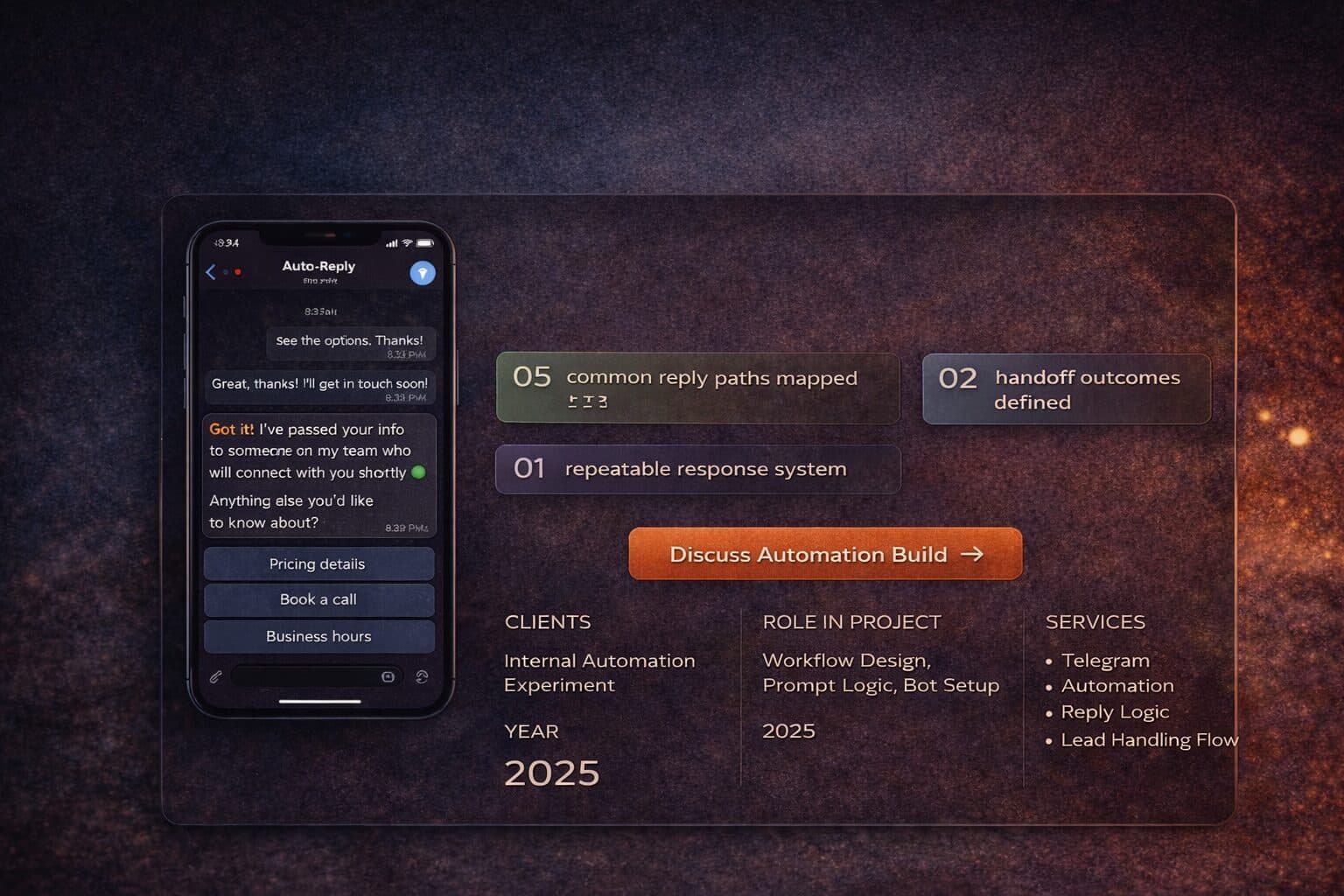
- 01Recognise a supported request
- 02Provide a useful response
- 03Hand off when needed
Keep a first reply useful and its limits visible.
Telegram Auto-Reply Bot explores a narrow operational task: handling common incoming messages and directing the conversation toward a useful next step. The aim of the concept is to organise repeatable reply paths rather than pretend every message can be resolved automatically.
The important planning question is what the automation is allowed to answer. A supported request can receive an approved response or a request for missing information. An unclear or unsupported question needs a fallback that does not trap the person in a loop.
A handoff needs context. When a conversation requires a person, the useful information is the original request, any details already supplied and the reason the automated path stopped. Asking the user to start over can remove much of the convenience of an immediate reply.
This is personal/demo work and an internal experiment. The page does not establish production reliability, a reduction in workload or any paid client deployment. The scope described here is a basis for discussing reply logic and boundaries.
Before using a similar workflow for a real business, define account ownership, allowed actions, duplicate-message handling and who monitors failures. Test unknown requests and repeated events. Any action that sends messages or changes records needs explicit authorisation and a way to pause the process.
- 01
Map common requests to approved responses instead of relying on vague all-purpose replies.
- 02
Keep clarification and human handoff available when the request falls outside the supported scope.
- 03
For a live implementation, verify duplicate handling, permissions and monitoring before relying on automated responses.
What the build set out to get right. These are intentions, not measured outcomes.
- 01Defined reply boundaries
- 02Clear next steps
- 03A human handoff plan
Use this project to explain the direction you want. The real scope, content and acceptance checks come from your brief.